accelerating soil regeneration for India
Prize fundINR 6.5 Cr
Powered by

accelerating soil regeneration for India
scale of the problem
in just one lifetime, we have farmed our way through soil that took millennia to form.
Hectares1
of degraded land in India — forests, croplands & pastures.
tonnes2
of topsoil lost every year — erosion rates of 16.4–21 t/ha/yr, almost double the permissible 11.2.
Hectares3
of cropland abandoned every year — because the soil can no longer produce.
of degraded land4
sits in dry, rainfed areas that produce 44% of India's food grains, 80% of its pulses, and 73% of its oilseeds.
statistics also informed by the^delta prize's consultations with agricultural experts and field practitioners.
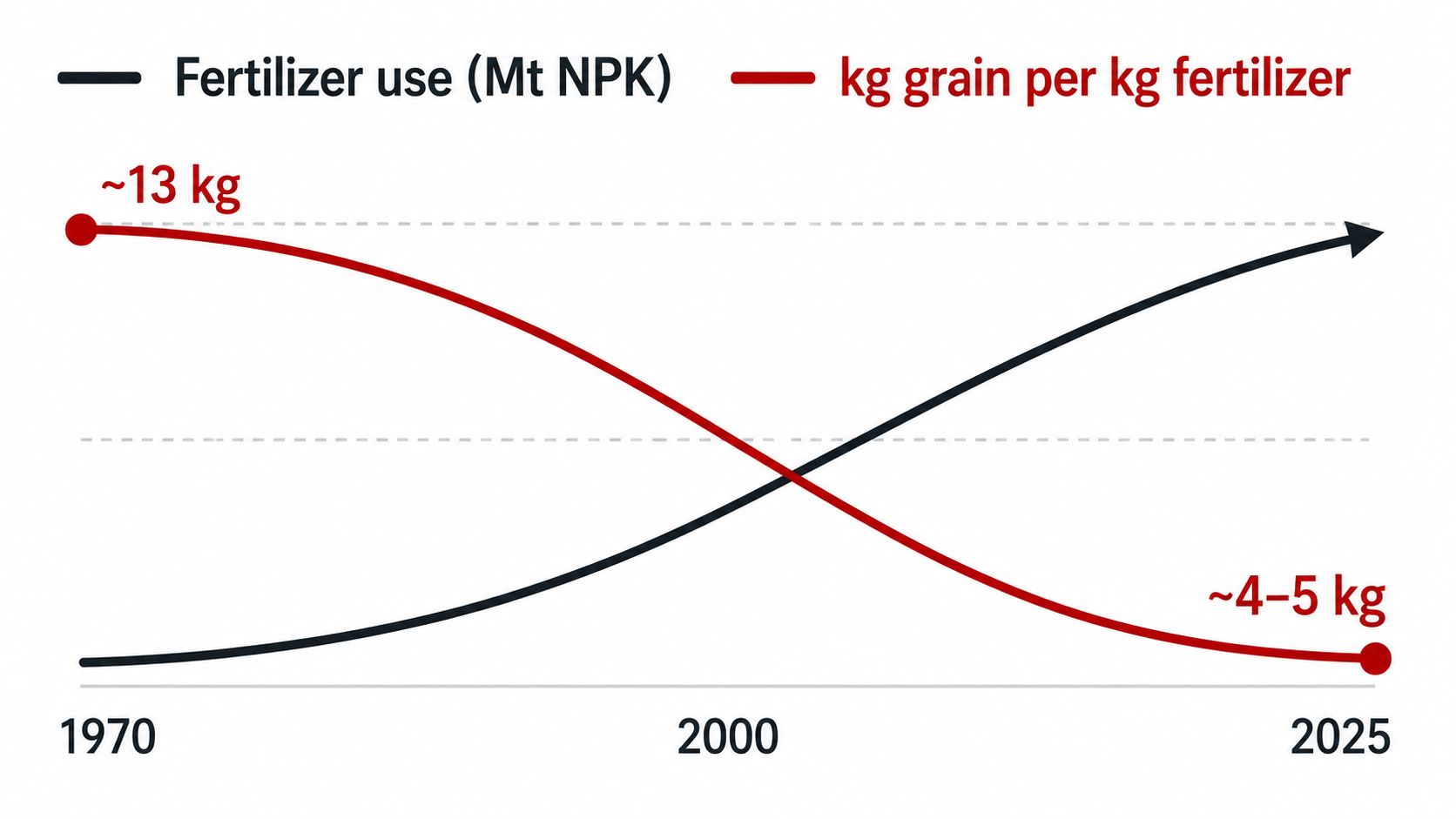
we are pouring in more inputs — fertilizer, water, pesticide — to hold yields flat on tired land. more input. lower output. that is the signature of a soil crisis.
how did we get here?
smallholder farmers are caught in a cycle: unsustainable practices and climate stress are depleting their soil — and their net incomes with it.
a · soil disturbance
we disturb the soil and everything living in it through over-tilling and stubble burning.
b · excessive inputs
we overdose the soil with chemicals — urea-heavy fertilisation, pesticide overuse and low-quality inputs applied out of fear, not diagnosis.
c · cropping patterns
we crop without rest — the same crops season after season, mining the same nutrients.
smallholders are locked in a vicious cycle of soil degradation
farmers know the soil needs regeneration — but for a smallholder, the transition to regenerative farming is a massive risk today:
90%+ of India's farmers remain locked into chemical-intensive practices — not for lack of will, but because the system makes the right thing the risky thing.
the opportunity
Degraded soils respond fastest to regeneration. Expert consultations show that highly degraded soils (SOC ≤ 0.3%) can gain 0.2%–0.3% of organic carbon within just two years — when regenerative practices are combined with novel biologicals.
the pathways are known, proven and farmer-ready:
cover crops
that shield and feed the soil between harvests
no-till or low-till farming
that leaves soil life undisturbed
crop rotation & intercropping
that restore nutrient cycles
mulching & residue retention
instead of burning
bio-fertilizers & microbial inoculants
composted manure that revive soil life
agroforestry & legume integration
that build long-term carbon
the question
not someday. not eventually. now — by finding the transition models that work, proving them at scale, and making regeneration the rational choice for every smallholder farmer.
introducing
farmer-centric, low-risk, high-yield regen pathways to regenerate India's soil and improve farmers' income.
Double soil organic carbon within 24 months and increase smallholder farmer net incomes by at least 25% through tech-enabled, replicable transition models for regenerative agriculture, reaching 5,000–10,000 farmers across at least 5,000 hectares within a cluster.
*A cluster is defined as 2–5 contiguous blocks within a district.
impact landscape
smallholder farmers practicing conventional agriculture, with baseline SOC ≤ 0.3%
crop types
cereals · oilseeds · pulses · fruits & vegetables · cash crops
prize fund
INR 6.5 Cr
what it takes to win
organisations will be progressively shortlisted across stages — based on the following non-negotiables:
credible track record of delivering field interventions at scale with smallholder farmers.
a clear model that puts farmer income, agency and adoption-readiness at the heart of the transition.
a coherent set of practices — soil, water, biology, advisory — that can credibly double SoC within 24 months.
a transition model that can move from one cluster to many, with clear unit economics and an adoption pathway.
commitment to baseline, midline and endline measurement — soil profiling and farmer economics — with full transparency.
the team, partnerships and field presence to begin implementation immediately after the cohort kick-off.
who should apply
timelines & journey
Jun – Jul '26
1open call for nonprofits & CSOs.
Aug – Oct '26
2jury review & field diligence.
Oct – Nov '26
35–8 challengers announced & onboarded.
PILOT GRANTNov – Dec '26
4understand starting point & plan interventions.
Feb – Mar '27
5unlock scale based on early progress.
DEPLOYMENT GRANTJun '27
6track progress & course-correct.
Apr – May '28
7assess impact achieved & outcomes.
Jun – Jul '28
8showcase impact & unlock scale-up.
FINAL SCALE-UP GRANTOct '28
9measure lasting soil health impact.
beyond the prize fund
Challengers gain access to capital, mentorship, third-party MEL and an ecosystem designed to turn proven regenerative models into scaled, real-world impact.
pilot-ground activation grant at kickoff, deployment grant in Year 2, and an outcome-linked scale-up grant for winners at the grand finale.
recurring 1-on-1 sessions across the 24-month journey with senior practitioners across soil science, livelihoods and scale-up.
warm introductions to CSR, philanthropic and impact-investor partners — relationships that typically take years to build, opened up in months.
government bodies & schemes, tech & startup partners, academia, research institutions, media and global agencies — connected to your model.
deep dives on regenerative science, scaling models, policy advocacy and the operational craft of running outcome-linked programmes.
narrative support, demo days and cohort visibility across major platforms — credibility that lifts your model far beyond the prize.
built on deep research
voices of the challenge

Former G20 Sherpa (India) | Former CEO, NITI Aayog
guiding the challenge on policy alignment, public systems and accelerating implementation pathways for India's regenerative transition.
advisors to the challenge
Former Secy, MoA & FW, GoI · Former Chief Secy, Odisha
Co-founder, ThinkAg · Agritech Expert
Executive Director, Centre for Sustainable Agriculture
frequently asked questions
The rapid re·gen challenge invites non-profits and civil society organizations (CSOs) to deploy farmer-centric, low-risk, high-yield regenerative agriculture pathways that regenerate India's soils while improving smallholder incomes. The challenge aims to:
The challenge is focused on building tech-enabled, replicable regenerative agriculture transition models that can scale across India.
The range allows organizations to design models suited to different farmer realities and landholding patterns. Applicants may choose to:
In both cases, the goal is to collectively reach at least 5,000 hectares under regenerative transition.
Non-profits, CSOs, and Section 8 organizations with valid 12A and 80G certifications are eligible to apply. Organizations working across areas such as:
are encouraged to apply. Cross-functional models combining multiple capabilities are welcome.
Applicants should demonstrate credible prior experience working with smallholder farmers in agriculture, natural resource management, sustainable agriculture, or related sectors. Organizations do not need to have previously executed a project at this scale, but should be able to demonstrate:
Newer organizations are encouraged to apply in partnership with experienced field organizations.
Yes. Applicants are not expected to build technology internally. However, the challenge is explicitly looking for tech-enabled and replicable transition models. Technology may include:
Organizations without in-house capabilities are encouraged to partner with agritech or research organizations.
For this challenge, regenerative agriculture refers to farming systems that actively regenerate soil health while improving farmer livelihoods and resilience. Solutions are expected to simultaneously contribute to:
The challenge does not prescribe a fixed list of practices. Applicants may propose combinations of practices suited to their agro-climatic and farming contexts, including composting and bio-inputs, crop rotation, intercropping, mulching, reduced tillage, agroforestry, biological pest management, moisture conservation, precision nutrient management, and regenerative advisory systems.
Solutions are expected to achieve, within 24 months: double soil organic carbon from baseline, increase farmer net incomes by ≥ 25%, and do so without increasing cultivation costs. These outcomes must be demonstrated across at least 5,000 hectares and 5,000–10,000 farmers.
Measurement is expected to include georeferenced soil sampling, baseline and periodic testing, accredited laboratory analysis, and standardized protocols across the cohort. Detailed measurement frameworks will be shared with shortlisted finalists.
The challenge will involve three stages:
Organizations will be progressively shortlisted through each stage based on implementation capability, credibility of the proposed model, farmer-centricity, scalability, evidence orientation, and operational readiness. Finalists will be selected after field visits and evaluation by the jury and M&E teams.
terms & conditions
explore the prize
the rapid re·gen challenge film
Why prize
why a prize
the philosophy and design principles behind the^delta prize
Research · climate
climate research
the deep research that shaped our climate futures theme
How it works
how the prize works
the multi-stage challenge architecture and selection process
Other challenges
all challenges
explore the wider portfolio of the^delta prize challenges
applications are open for nonprofits and CSOs with existing farmer networks and the capacity to deliver regenerative transitions at cluster scale.
A Climate Futures initiative by the^delta prize · Powered by PepsiCo